
For most Las Vegas venues, you need a short-term policy with $1 million per occurrence and $2 million aggregate in general liability, naming the venue as Additional Insured. If alcohol is served, add liquor liability, whether your bartending vendor carries it or you do. The move right now: confirm your venue’s exact wording, buy a policy that issues a same-day Certificate of Insurance (COI), and email it over before you lose sleep over it.
- $1M/$2M general liability is the standard ask at most Las Vegas venues
- Liquor liability gets added whenever alcohol is served, by host or vendor
- Same-day COI issuance, sent directly to your venue contact, closes the loop
Pro Tip: Ask your venue for their exact COI wording in writing before you buy anything. Insurers can match it precisely, but only if you hand them the right language up front.
Key Takeaways
Securing compliant event insurance in Las Vegas comes down to matching venue-required limits and COI wording before you buy, then confirming liquor liability separately if alcohol is involved.
| Point | Details |
|---|---|
| Confirm venue limits first | Most Las Vegas venues want $1M per occurrence and $2M aggregate, naming the venue as Additional Insured. |
| Get liquor liability if serving alcohol | Host or vendor liquor liability is typically required, and some venues want both layers. |
| Time your food permit separately | Southern Nevada Health District wants temporary food permit applications at least 7 days before the event. |
| Choose insurers with same-day COI | Online-first insurers issue certificates instantly, which matters when your event date is close. |
| Consider a licensed bartending vendor | Liquid Courage LV supplies its own liquor liability coverage and vendor COIs, reducing what a host has to insure separately. |
Table of Contents
- What Types of Event Insurance Coverage Do You Need in Las Vegas?
- What COI Wording Do Las Vegas Venues Actually Require?
- How Much Does Event Insurance Cost in Las Vegas?
- How Do You Get a Certificate of Insurance Fast in Las Vegas?
- Do You Need Separate Liquor Liability If You Hire a Bartender?
- How Liquid Courage LV Sees the Insurance Side of Event Bartending
- Need a Bartender Who Already Handles the Insurance Paperwork?
- Sources
What Types of Event Insurance Coverage Do You Need in Las Vegas?
Four coverages come up again and again for Las Vegas events, and not every host needs all four.
General liability is the backbone, especially when you consider risks from rented equipment like furniture, which event organizers can better manage by working with reliable event furniture rental suppliers. It pays for bodily injury or property damage claims tied to your event, like a guest slipping near the dance floor or a rented table gouging a hardwood floor. Nearly every venue requires it before they’ll hand you the keys.
Liquor liability covers claims connected to alcohol service, and it splits into host liquor liability and vendor (liquor) liability depending on who’s actually pouring. If you hire a licensed bartender, that vendor typically carries their own liquor liability policy naming your event.
Event cancellation coverage reimburses deposits and expenses if you have to postpone or cancel, though watch for exclusions. Communicable disease exclusions are common now, so read that section closely before assuming a policy covers everything.
Equipment coverage, sometimes called inland marine, protects rented AV gear, staging, or lighting against theft or damage. It’s optional for a backyard birthday but worth adding when you’re renting five figures’ worth of production equipment for a corporate gala.
- General liability: bodily injury and property damage claims
- Liquor liability: host or vendor coverage for alcohol-related incidents
- Event cancellation: deposit and expense reimbursement, with exclusions
- Equipment/inland marine: optional coverage for rented AV and staging
What COI Wording Do Las Vegas Venues Actually Require?
Venue requirements aren’t uniform across the valley, and the fastest way to get your certificate rejected is guessing at the language instead of asking.
- Additional Insured naming. Your policy needs to list the venue by its exact legal name, not the name on its marquee. Resorts often use a different corporate entity than the property brand.
- Primary and noncontributory wording. Many venues require this clause, which means your policy pays first before the venue’s own insurance kicks in.
- 30-day cancellation notice. Some venues want written confirmation that your insurer will notify them 30 days before any policy cancellation.
- Jurisdiction clarity. An event on the Strip may sit on private resort property, while a park event falls under Clark County or the City of Las Vegas, and naming the wrong governing entity is a common reason COIs get bounced back at the door.
- Higher limits for large or public events. Stadiums and convention-scale bookings can require $5 million or more, sometimes with property-specific endorsements layered on top.
Pro Tip: Call your venue’s event coordinator directly and ask who at the venue reviews the COI. Some resorts route certificates through a risk-management department that isn’t the same person who booked your date.
How Much Does Event Insurance Cost in Las Vegas?
Budget expectations vary more by risk factors than by event type alone. A small private party with no alcohol might land near the lower end of the market, while a wedding with an open bar and a live band sits meaningfully higher. Quotes for small weddings often start around $60 to $150 depending on which coverages you stack, and some bare-bones single-day policies price even lower for minimal-risk gatherings.
What actually drives the number up: guest count, alcohol service, hired entertainment, and anything resembling a high-risk activity (mechanical bulls show up more often than you’d think). Corporate events with 200-plus attendees and a full bar cost more to insure than a 30-person backyard shower, and that gap widens fast once liquor liability and cancellation coverage both get added.
- Guest count and venue capacity
- Alcohol service and bar type
- Hired vendors, entertainment, and equipment rentals
- Event duration and setup/teardown windows
Timing matters just as much as price. Some carriers run manual underwriting that adds days to approval, while online-first insurers issue instant certificates, which matters if your event is two weeks out. If food service is part of the plan, remember the Southern Nevada Health District requires temporary food permit applications at least 7 calendar days before the event, a separate clock from your insurance timeline that trips up more hosts than it should.
How Do You Get a Certificate of Insurance Fast in Las Vegas?
Getting a compliant COI in hand doesn’t take long if you approach it in order instead of backward.
- Confirm venue wording first. Get the exact Additional Insured language, required limits, and any primary/noncontributory clause before you request a single quote.
- Gather your event details. Date, guest count, alcohol service, hired vendors, and any rented equipment all factor into an accurate quote, so have them ready.
- Request the right endorsements. Ask specifically for Additional Insured wording, primary/noncontributory status, and a waiver of subrogation if your venue’s contract calls for one.
- Get the COI and send it immediately. Email it to your venue contact and any vendors who need it, then follow up to confirm they’ve actually accepted it, not just received it.
- Chase down vendor COIs too. Every hired vendor, including your bartending service, should hand you a certificate listing your specific event name and date, not a generic annual policy.
Pro Tip: Keep a single folder, digital or physical, with your COI and every vendor’s COI together. Venues sometimes ask for all of them at load-in, and scrambling through email threads in the parking lot is a bad look.
Do You Need Separate Liquor Liability If You Hire a Bartender?
Serving alcohol changes your insurance math, and most venues won’t let you skip this step even when a licensed vendor is pouring the drinks.
Host liquor liability covers you as the event organizer if someone becomes overserved and causes harm. Vendor liquor liability, carried by your bartending company, covers the vendor’s own service. Some venues require both, on the logic that they want two layers of protection rather than relying on one policy alone.
Hiring a licensed mobile bartender with its own liquor liability coverage genuinely reduces your exposure and often satisfies venue requirements that a self-serve bar never could. It also cuts down your paperwork, since the vendor supplies its own COI rather than you scrambling to add liquor coverage to a general policy.
Watch for red flags: a vendor COI that omits liquor liability entirely, missing Additional Insured language, or a certificate listing the wrong event date. Any of those can get your bar service turned away at the door, and reviewing what event insurance actually needs to cover for bartending before you sign a vendor contract saves that headache.
- Host liquor liability protects you as the organizer
- Vendor liquor liability protects the licensed bartending company
- Some venues require both layers, not just one
- Check every vendor COI for correct dates and liquor liability language
How Liquid Courage LV Sees the Insurance Side of Event Bartending
Working events across Las Vegas and Henderson week after week means constant contact with venue coordinators who check paperwork at the door. That vantage point makes one thing obvious: hosts who confirm insurance wording early almost never have day-of problems, and hosts who wait until the week before almost always do.
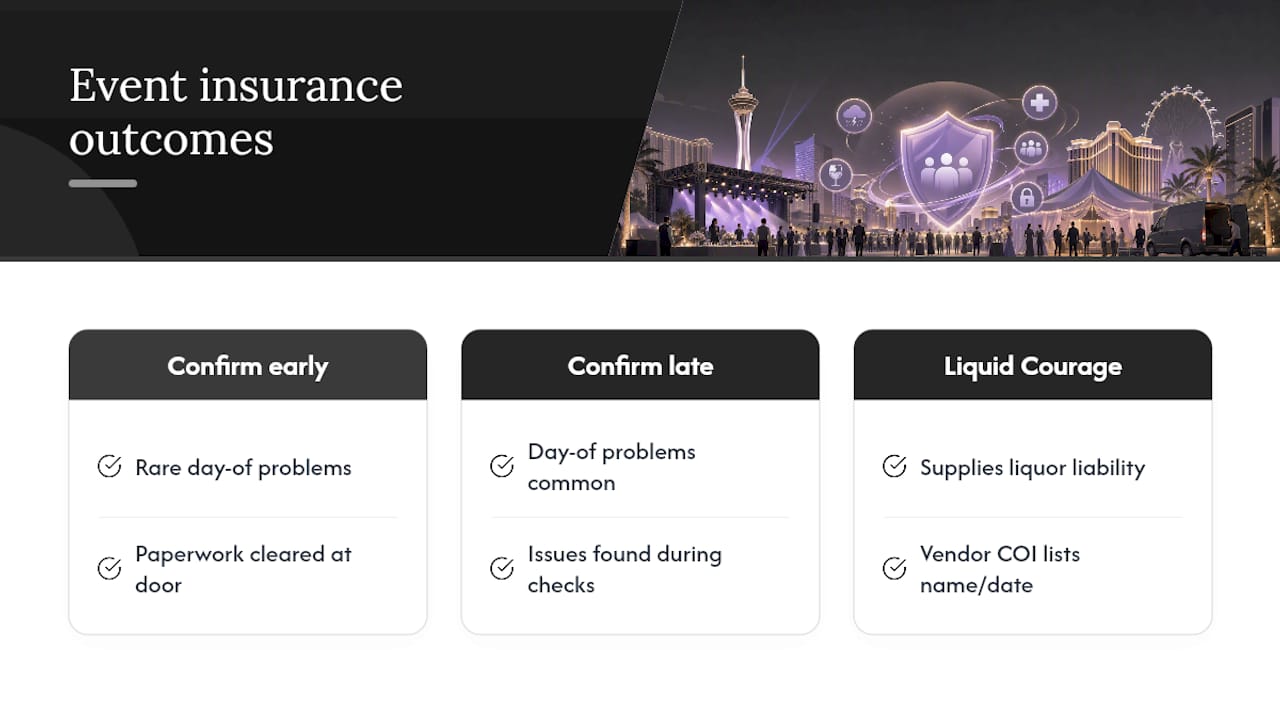
As a licensed mobile bartending provider, Liquid Courage LV supplies its own liquor liability coverage and vendor COIs listing the correct event name and date, which takes one variable off a host’s plate entirely…
— Brennon
Need a Bartender Who Already Handles the Insurance Paperwork?
Buying event insurance solves the liability side. It doesn’t solve who’s actually pouring drinks, keeping the bar compliant, or handing your venue a clean vendor COI without three follow-up emails. That’s the gap Liquid Courage LV fills for hosts across Las Vegas and Henderson.
Liquid Courage LV isn’t an insurance company. It’s a licensed mobile bartending and liquor catering service, and every booking comes with its own vendor coverage and a COI that lists your event’s exact name and date, ready to send straight to your venue contact. That means one less certificate for you to chase down while you’re also managing caterers, rentals, and a guest list. For weddings, corporate events, and private parties, this covers your bar service and your paperwork in a single call. Check dates and get a quote through the event bartending hiring guide, or start with the Las Vegas mobile bartending services page to see what’s available for your date.
Sources
- Special events — Southern Nevada Health District
- Nevada event insurance — Special Event Insurance
- Special Event Insurance — TheEventHelper