
Plan on a measured amount of mixer per cocktail, a realistic estimate of drinks per person over the night, and a buffer on top. Event length, whether you run a full bar or beer and wine, and how many signature cocktails you serve can all push that number up or down. Start with the checklist below, then adjust.
TL;DR:
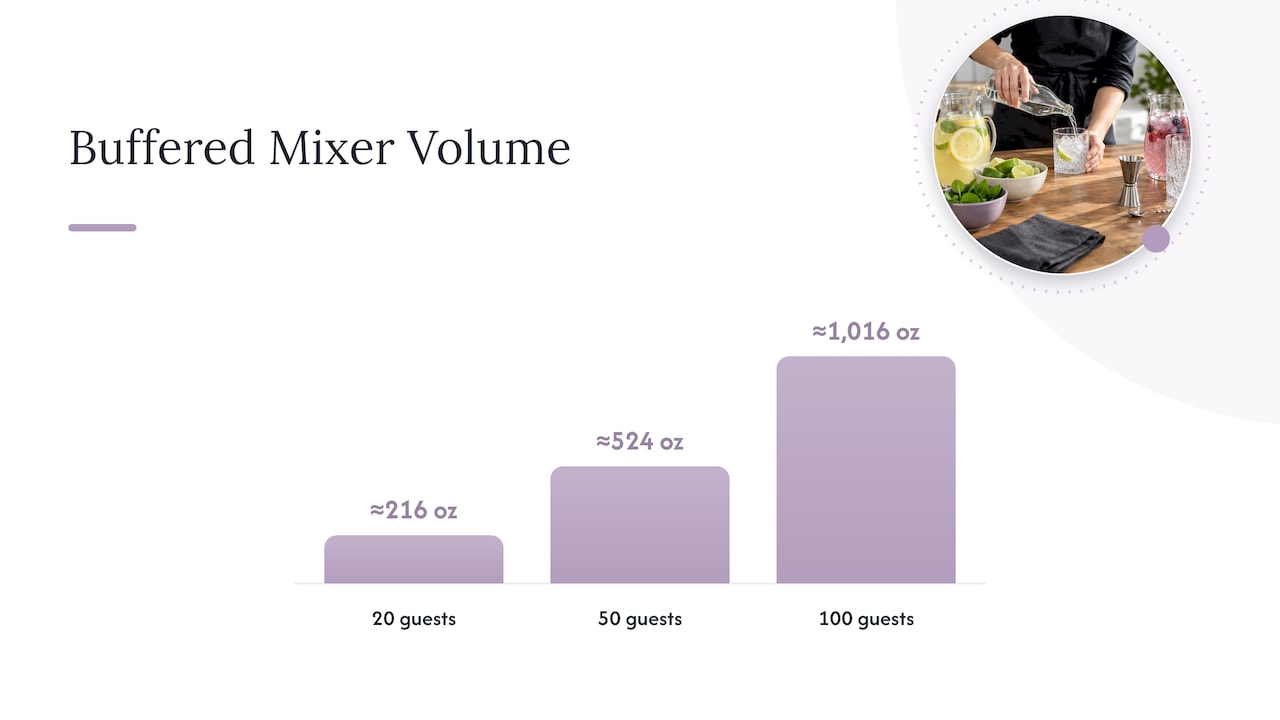
- For planning, assume about one third of guests drink spirits; at seven cocktails each, a 20 person event needs about 216 ounces of mixer, including a buffer.
- At the same assumptions, plan roughly 15 to 16 liters for 50 guests and about 30 liters for 100, then round every purchase up.
- Raise the buffer for long open bar events or crowds that favor hard liquor; lower it only with a firm headcount and a limited menu.
- Count nonalcoholic guests separately and stock sparkling water, ginger beer, juice, and citrus based on their own demand; keep these mixers clearly separated.
- Keep the cocktail menu short, size each ingredient from recipe portions and expected orders, and favor flexible mixers such as soda, tonic, cola, and lime.
Table of Contents
- 1. Which mixers should you buy, and how do you scale them?
- 2. How does the mixer calculator math work?
- 3. What do the numbers look like for different guest counts?
- 4. How do ice, garnishes and storage change your mixer needs?
- 5. What do bartenders do differently when buying, batching and serving?
- 6. How does your cocktail menu change the mixer math?
- 7. What about non-alcoholic guests and specialty mixers?
- 8. How do seasons and themes change what you buy?
- 9. Why does careful quantity planning make for a better event?
- 10. When is it worth hiring a bartending service?
- FAQ
- Sources
1. Which mixers should you buy, and how do you scale them?
Every full bar needs the same core list. Scale each line to your crowd, then round up to full bottles, liters or cartons.
- Cola and diet cola: Buy in large bottles or cans. Increase for rum or whiskey crowds.
- Club soda: Liter bottles work best. Raise it if you serve vodka sodas or highballs.
- Tonic water: Liter bottles. Increase for gin and vodka crowds, and in hot weather.
- Ginger ale and ginger beer: Liter bottles or four-packs. Add more if you feature a mule or a Moscow-style signature drink.
- Cranberry juice: Large cartons. Increase for cosmopolitans, vodka cranberries and punches.
- Orange juice: Large cartons. Plan extra for brunch events and mimosas.
- Lime and lemon juice or fresh citrus: Fresh limes by the bag, bottled juice as backup. Increase for margaritas and any citrus-forward signature drink.
- Simple syrup: Quart bottles or a homemade batch. Increase for sours, mojitos and old fashioned.
A baseline list for 20 guests covers tonic, club soda, cola, diet cola, ginger ale, cranberry juice, orange juice, lime and simple syrup. Scale proportionally from there: double it for 40, multiply by five for 100.
If your crowd leans heavily toward one spirit, shift your mixer ratios to match. A tequila crowd needs lime and soda, not extra cola. Hot weather raises consumption of everything, especially the light mixers like soda and tonic. Anything sold in large containers should be rounded up, never down, because a partly used container costs far less than a dry bar.
2. How does the mixer calculator math work?
Most wedding-bar calculators use a simple chain of assumptions. Knowing them lets you adapt the math instead of trusting a number blindly.
- Mixer per cocktail: A mixed drink needs an amount of mixer suited to its recipe. That is what you pour on top of the spirit, so it drives how many bottles and cartons you buy.
- Drinks per guest: Estimate drinks per person based on the event and your guests. Shorten the event and this drops; lengthen it and it climbs.
- Share of spirit drinkers: Calculators may assume that only some guests drink spirits. The rest drink beer or wine, which need no mixers. If your guest list skews toward cocktails, raise that share. If you serve a beer and wine bar, lower it sharply.
- Buffer: Add a buffer to the total. That covers heavy pours, spills, a thirsty table and the guest who orders three ginger ales.
Here is the chain in practice. For a sample calculation, estimate the number of guests drinking spirits, multiply by the expected drinks per person, then multiply by the mixer amount per drink. Add a buffer to the total. Divide by the size of your bottles and cartons to get a shopping count.
A common full-bar formula: estimate the share of guests drinking spirits, the drinks per person, and the mixer amount per cocktail, then add a buffer.
Raise the buffer for long events, open bars with no ticket limit, or crowds that skew toward hard liquor. Drop it only when you have a firm headcount and a tight menu.
3. What do the numbers look like for different guest counts?
Turn the rules into a shopping list in four steps:
- Multiply guests by the share drinking spirits (about one third) to find your spirit drinkers.
- Multiply by the expected drinks per person to find total cocktails.
- Multiply by the mixer amount per cocktail to get the total mixer volume, then add a buffer.
- Split that total across your mixers and round up to whole bottles.
Using those assumptions, the totals work out like this:
- 20 guests: about 7 spirit drinkers, 49 cocktails, 196 ounces, about 216 with buffer. That is under 7 liters of mixer in total, so one bottle each of your core mixers covers most of it.
- 50 guests: about 17 spirit drinkers, 119 cocktails, 476 ounces, about 524 with buffer. Think roughly 15 to 16 liters spread across your list.
- 100 guests: about 33 spirit drinkers, 231 cocktails, about 1,016 ounces with buffer. That is roughly 30 liters of mixer, so cases and multi-packs start to make sense.
Round up to full retail sizes on every line. Unopened bottles and cartons can usually go back or be saved, while an empty one cannot be refilled. Cola, club soda and tonic typically take the largest share, so give them the biggest allotment and treat the juices as the smaller lines.
Adjust the totals for the situation. A shorter reception needs fewer drinks per person than a longer one, so adjust your estimate accordingly. Heavy-drinking crowds, such as bachelor parties or a hosted open bar, deserve a bigger buffer.
4. How do ice, garnishes and storage change your mixer needs?
Mixers do not exist in isolation. These logistics shape how much you really need on site.
- Ice: More ice changes pour speed and dilution, and that shifts how much mixer lands in each glass. Our guide to ice per guest walks through the pounds-per-guest math.
- Garnishes: A simple rule is citrus cut into wedges, plus cherries and olives, with quantities adjusted to your guest count and menu.
- Refrigeration: Cartons and bottles take up real cooler space. Count your cooler capacity before you buy, since only what stays cold gets used.
- Backup stock: Keep unopened extras in a cool back area so the bar can restock without leaving the line.
5. What do bartenders do differently when buying, batching and serving?
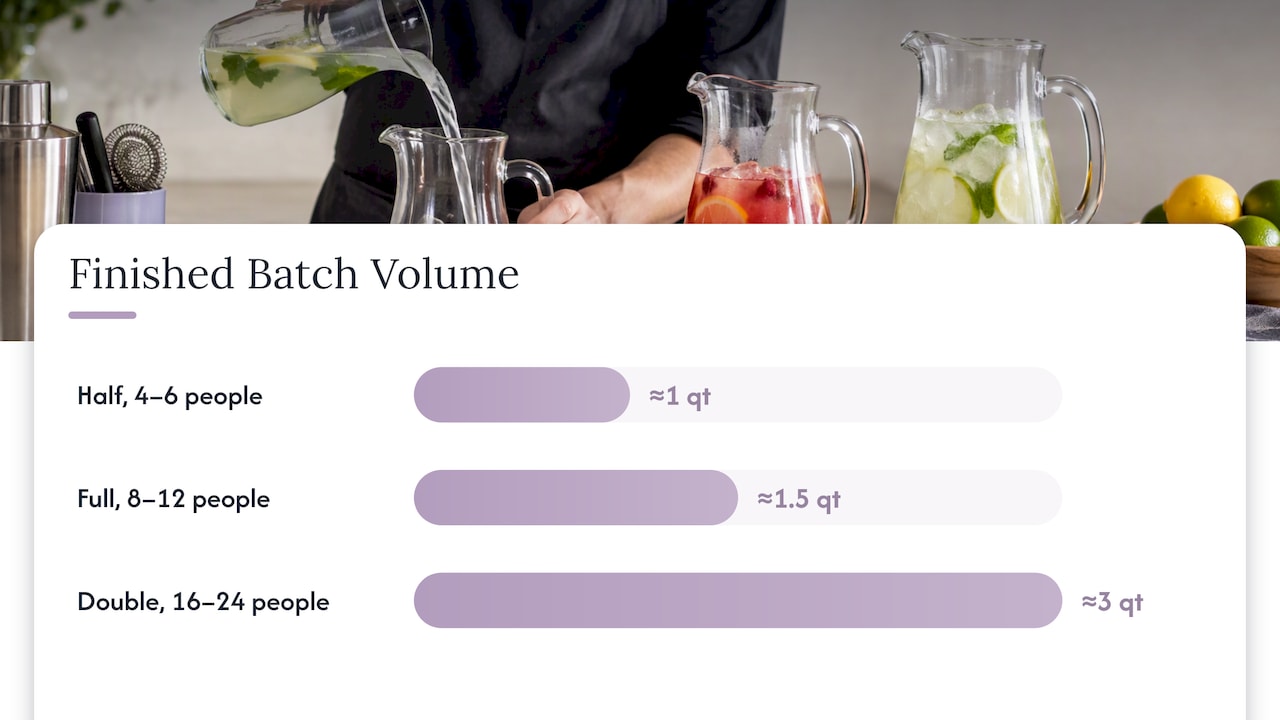
Batching saves time, but only if the containers match the volume. Big-batch guidance maps recipe sizes to finished volume: a half recipe serves about 4 to 6 people, roughly a quart; a full recipe serves 8 to 12 people, about 1.5 quarts; and a double recipe serves 16 to 24 people, about 3 quarts. Pick containers sized to the finished batch, not the starting ingredients.
Label every container with the drink name and the date. Pre-batch what you can before guests arrive, and keep a measured pour for each drink so portions stay consistent. We cover the timing side in our post on faster bar service with pre-batched cocktails.
Retail sizes are fine for most home and small events. For larger events, catering-sized containers cut down on trips and storage clutter. Order a few days ahead and confirm delivery times so nothing arrives after setup.
Pro Tip: Buy one extra case of your top two mixers and keep it sealed. Returning unopened stock is easy; a mid-party store run is not.
6. How does your cocktail menu change the mixer math?
The 4-ounce rule assumes a fairly simple bar. A bigger menu spreads demand across more ingredients, which usually means you need more total variety but less of each item.
Start with a short menu. A short list of signature cocktails plus a few classics keeps the shopping list tight. Each extra cocktail adds new mixers and leftovers, and a drink few guests order still demands a full bottle of something.
Use the recipes themselves to size things. Classic cocktail references list exact spirit and mixer proportions, which lets you convert a drink count into bottle needs. Multiply the mixer portion by how many of each drink you expect, then add the buffer to each line.
Variations matter too. A highball takes far more soda than a spritz. A sour needs more citrus and syrup than a gin and tonic. If you offer both frozen and shaken drinks, add juice and syrup to the list. When you cannot predict what guests will order, weight the plan toward the flexible mixers: club soda, tonic, cola, cranberry, orange juice and lime.
7. What about non-alcoholic guests and specialty mixers?
Non-alcoholic guests still drink all night, and they often drink more mixers than anyone, because soda, juice and sparkling water are their whole menu. Count them separately instead of assuming they are covered by the cocktail math.
Plan a few real options rather than only cola. Sparkling water, ginger beer, cranberry and orange juice, and a simple mocktail with fresh citrus all feel like part of the party. Group the mocktail ingredients into the same shopping list so you avoid doubling up on cartons.
Specialty mixers need their own line:
- Non-alcoholic spirits and bitters work well in zero-proof drinks. Buy a bottle or two, not a case.
- Premium sodas and craft ginger beer cost more per bottle, so buy to expected use rather than rounding up aggressively.
- Sugar-free and diet options deserve their own quantity, since guests who choose them rarely switch.
Keep non-alcoholic mixers in a separate cooler or a clearly marked section so they stay available for everyone, including designated drivers and guests who do not drink alcohol. A good rule is to stock them generously, because they are the cheapest items on the bar and the most used.
8. How do seasons and themes change what you buy?
Season and theme shift both the type and the volume of mixers.
- Summer and outdoor events: People drink more, and they drink lighter. Increase club soda, tonic, lemonade, citrus and ice, and add a cooler for backup.
- Fall and winter: Guests lean toward richer drinks. Plan more cider, ginger beer, cranberry and spiced syrups, and fewer light sodas.
- Brunch themes: Orange juice, sparkling wine and Bloody Mary mix move fast. Buy juice by the carton and expect it to go.
- Wedding signature drinks: A couple’s custom cocktail can account for a big share of orders. Size that drink’s ingredients first, then fill in the rest of the bar.
- Tropical or tiki themes: Pineapple, coconut, lime and simple syrup take over the list.
- Corporate receptions: Guests often drink fewer cocktails and more water and soda, so trim spirits mixers and add non-alcoholic options.
Themes narrow the menu, which usually makes shopping easier. A tighter menu means fewer ingredients, bigger quantities of each, and less waste at the end of the night.
9. Why does careful quantity planning make for a better event?
I’ve found that the best-run bars are the ones nobody notices. When the mixers are counted, chilled and within reach, service stays fast, lines stay short and the host stays at the party. Careful planning can help prevent running dry and over-buying. It also saves money, since a few minutes with a calculator beats a last-minute run to the store. That experience comes from years of event bartending at Liquid Courage.
— Brennon
10. When is it worth hiring a bartending service?
If counting ounces and chilling cartons sounds like more than you want to manage, we can take it off your plate. Hiring a professional makes sense for larger events, venues with strict alcohol rules, or any party where you would rather host than haul ice. Our mobile bartenders handle stocking, staffing, legal compliance and cleanup, so you get a working bar without the guesswork.
We offer wedding bartending and private bartender packages for events across Las Vegas and Henderson. Reach out through our website and we will put together a quote for your guest count and menu.
FAQ
How much drinks for 20 guests?
Estimate how many guests will choose mixed drinks and how many they may have, then calculate mixer needs from your menu. Add a buffer and keep the list focused on your core mixers.
What is the 2:1:1 rule for cocktails?
A sour-style cocktail balances spirit, citrus and sweetener. Check a specific recipe for its proportions. It helps you estimate how much lemon or lime juice and simple syrup to buy when your menu includes sours.
How many drinks do you need for 100 guests?
Estimate the drinks guests may have over the event, then calculate mixer needs from your menu. Round your mixer counts up and add a buffer.
What is the 3:2:1 cocktail rule?
The 3:2:1 rule is a ratio some bartenders use for certain sours and punch-style drinks, with three parts of the base, two of a second ingredient and one of a third. Always check the specific recipe, since proportions vary by drink.
Sources
- Big Batch Cocktails – Great Research
- Appendix B Classic Cocktail Quick Reference – Dining Room & Beverage Management for Culinary Students