

Yes, you need a permit to serve alcohol samples in Nevada. Depending on your event, that means an Alcoholic Beverage Tasting Permit, a temporary off-premise permit, or a liquor caterer permit, and it’s your local city or county licensing office (not the state) that issues most of them. Grocery stores serving samples on their own floor follow NRS 597.225 directly. Start with your county’s business licensing department, like Clark County’s temporary events division, before you commit to a date.
TL;DR:
- Organizers must choose the correct permit from multiple options: in-store tasting, temporary event, or liquor catering, based on their event setting and scope.
- Most permits are issued by local city or county licensing offices, with Clark County’s permits often being free but requiring detailed staffing and documentation.
- Out-of-state suppliers need a separate certificate of compliance with a $50 initial fee and annual renewal, adding to overall costs.
- Hiring a licensed liquor caterer simplifies compliance, as they handle sourcing, staffing certification, and permit logistics in Nevada.
- Lead times can range from a few weeks for simple in-store tastings to 8-12 weeks for multi-permit events or larger festivals, emphasizing early planning.
Table of Contents
- Alcohol Sampling Permit Nevada Options: Which One Fits Your Event
- Who Issues Your Permit: City, County, or State
- How to Apply for an Alcohol Sampling Permit in Nevada
- Staffing, Purchasing, and Serving Rules You Cannot Skip
- Fees, Renewals, and Realistic Timelines
- Where Nevada Event Organizers Actually Lose Time on Permits
- Official Forms and Who to Contact
- Why Hiring a Licensed Provider Changes the Permit Math
- Skip the Permit Headache With Liquid Courage LV
- Sources
- FAQ
Alcohol Sampling Permit Nevada Options: Which One Fits Your Event
Nevada doesn’t have one universal “sampling permit.” It has several, and picking the wrong one is the single most common reason organizers get stuck rescheduling an event two weeks out. Here’s how the three main paths break down.
The Alcoholic Beverage Tasting Permit covers retail environments, mainly grocery and liquor stores that want to let customers taste products before buying. This permit traces back to NRS 597.225, which allows a grocery store already licensed to sell alcohol at retail to serve samples on its premises, provided it holds an annual permit from the local governing body and buys its sample stock from a licensed wholesaler, not off the shelf. In Clark County, this permit runs through the Files application and, notably, it carries no fee. That’s an unusual break in a licensing world where almost everything costs something.
Temporary off-premise permits cover the opposite scenario: alcohol served somewhere that isn’t already a licensed retail floor. Think festivals, expo booths, brewery pop-ups at a park, or a one-day tasting at a venue with no standing liquor license. These are issued for a specific date range and location, and the Clark County Temporary Events FAQ walks through when each type applies, including situations where an event needs more than one permit stacked together.
Liquor caterer permits exist for exactly what they sound like: a licensed caterer providing alcohol service at someone else’s event, like a wedding reception or corporate holiday party. This is the permit type most relevant if you’re hiring outside help rather than running the bar yourself, and it shifts a meaningful share of the compliance burden onto the caterer instead of the event host, according to Clark County’s liquor and gaming guidance.
Here’s a quick way to sort which one applies to your situation:
- Running a tasting inside your own grocery or liquor store? You want the Alcoholic Beverage Tasting Permit under NRS 597.225.
- Hosting a one-time public or private event with no existing liquor license on-site? You need a temporary off-premise permit.
- Hiring a licensed bartending or catering company to pour at a wedding, corporate function, or private party? The caterer typically holds the liquor caterer permit, and your job is confirming they actually have it before signing a contract.
- Running a multi-day festival with vendors, live music, and ticketed admission? You may need several permits layered together, not just one.
The scenario that trips people up most is the hybrid: a retail store that wants to host an “event” style tasting with a DJ and extended hours rather than a standard in-aisle sample station. That’s no longer a simple tasting permit situation. It usually needs a temporary event layer on top, and figuring that out before you print invitations matters more than it sounds. If your event involves a beverage station setup with any kind of production value, it’s worth reviewing beverage station ideas built around what county rules will actually allow.
Who Issues Your Permit: City, County, or State
Nevada alcohol licensing splits cleanly along one line: local governments handle who can pour and where, while the state handles who can sell and supply. Mixing these up wastes weeks.
Cities and counties issue the permits you’ll deal with directly for sampling events. Clark County, Las Vegas, Henderson, and Reno each run their own licensing divisions, and while the paperwork looks similar across jurisdictions, fee schedules and processing windows do not match exactly. Clark County’s temporary events office handles applications for unincorporated areas and coordinates with the incorporated cities when an event crosses boundaries, which happens more often than you’d think along the Strip corridor where county and city lines interleave.
The Nevada Department of Taxation sits above all of that, handling state-level licensing: importer and wholesaler registration, certificates of compliance for out-of-state suppliers, and excise tax administration. If you’re an event organizer sourcing samples through a normal licensed distributor, you generally won’t touch the Department of Taxation directly. If you’re a supplier bringing product into Nevada from out of state, you will, and that process includes a $50 initial certificate of compliance fee with a $50 annual renewal, per the Department’s own guidance.
The submission flow usually looks like this:
- Local licensing board reviews your application first, checking zoning, venue authorization, and applicant background.
- If your event touches wholesale or import activity, the local board coordinates with or forwards documentation to the state.
- Clark County accepts both mailed and, in many cases, online submissions, but processing times differ. Mailed applications typically take longer to confirm receipt, so if your event date is firm, submit early and follow up by phone rather than assuming silence means approval.
Reno and Washoe County run a parallel but separately administered system, so don’t assume a Clark County approval or fee schedule transfers north. Always check with the specific jurisdiction where your event physically takes place.
How to Apply for an Alcohol Sampling Permit in Nevada
Getting this right the first time saves you a resubmission cycle, and resubmissions are what blow up event timelines. Here’s the order that actually works.
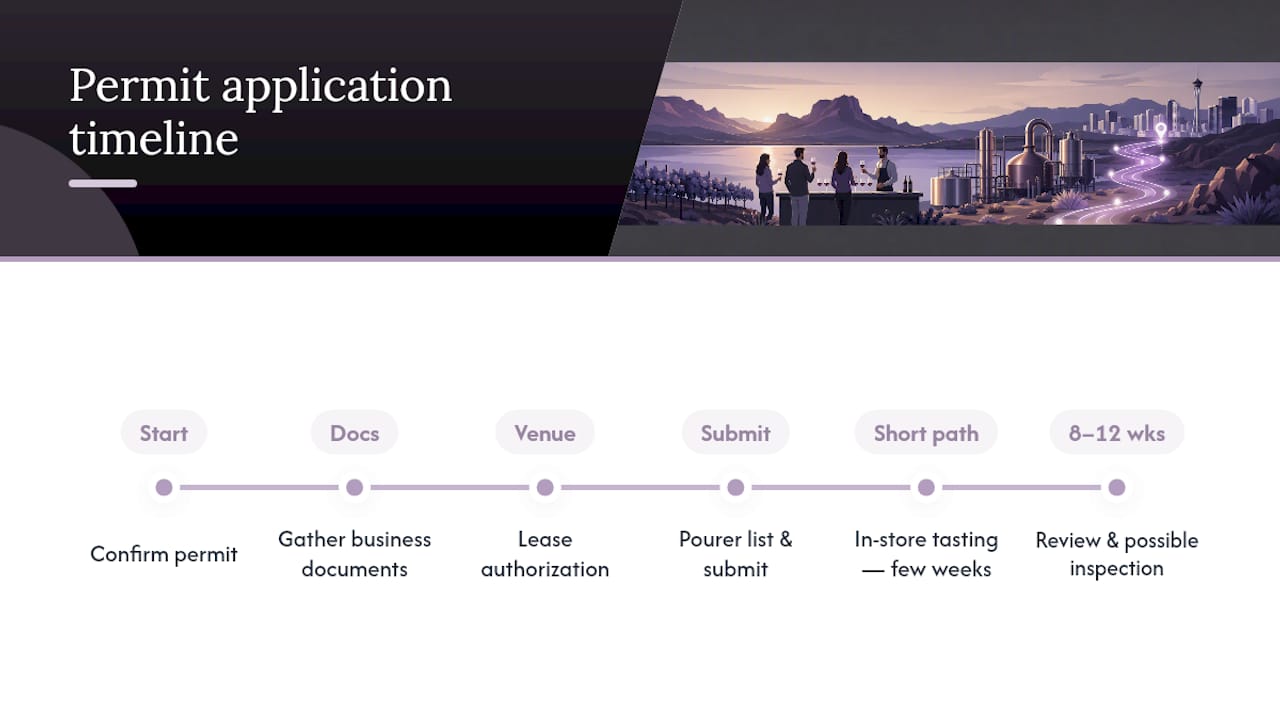
1. Confirm which permit applies to your event. Use the decision points above: retail tasting, temporary off-premise, or liquor caterer. Call your local licensing office if you’re unsure. A five-minute phone call beats a rejected application every time.
2. Gather your business documentation. You’ll typically need your Nevada Business Registration, any relevant Federal TTB permits if you’re a supplier or importer, and identifying information for the business owner or officers responsible for the license.
3. Secure venue and lease authorization. If you’re not the property owner, you need written permission from whoever holds the lease or venue rights. Licensing offices routinely reject applications missing this piece, especially for outdoor or shared-space events.
4. Line up insurance proof. Liability coverage is standard practice for any event serving alcohol, and most venues require it as a condition of use before licensing paperwork even gets submitted.
5. Build your master list of pourers. Clark County’s tasting permit application requires that every person distributing samples appear on a master employee list, and a key employee must be present the entire time samples are being poured, per the PL108 application. Skipping this step is one of the most common reasons applications bounce back.
6. Submit to the correct office. Clark County applications go through its business licensing and temporary events division; incorporated cities like Las Vegas, Henderson, and Reno each maintain separate submission points. Check whether your jurisdiction accepts online filing or requires mail, since that changes your realistic timeline.
7. Pay applicable fees. The tasting permit itself carries no fee in Clark County, but temporary event permits and liquor caterer permits often carry per-day rates, and some application fees are nonrefundable regardless of outcome, according to the Clark County Temporary Events FAQ.
8. Wait for review and possible inspection. Larger events, especially those involving outdoor space, tents, or multiple vendors, may trigger a site inspection before final approval.
Pro Tip: Budget 8 to 12 weeks of lead time for anything beyond a simple in-store tasting, especially if your event needs more than one permit type stacked together. A straightforward grocery store sample station under NRS 597.225 can move faster, sometimes within a few weeks, but multi-permit events tied to festivals or large private parties routinely take the full window once you account for insurance paperwork and venue sign-off.
The timeline compresses dramatically when you hire a licensed caterer who already holds the liquor caterer permit, since you skip most of the state and local paperwork entirely and inherit their existing compliance standing instead.
Staffing, Purchasing, and Serving Rules You Cannot Skip
Getting the permit is half the job. Staying compliant on the actual day of the event is the half that generates violations if you cut corners.
Who can pour matters as much as who applied for the permit. Every person distributing alcohol samples needs a valid health card and alcohol awareness certification, a requirement baked directly into the county’s tasting permit form language. This isn’t a suggestion. Inspectors check it, and an uncertified pourer at your station can jeopardize the whole event’s compliance standing even if the paperwork upstream was perfect. If you’re building out staffing for an event, a hiring checklist for bartending staff is worth reviewing before you finalize your roster.
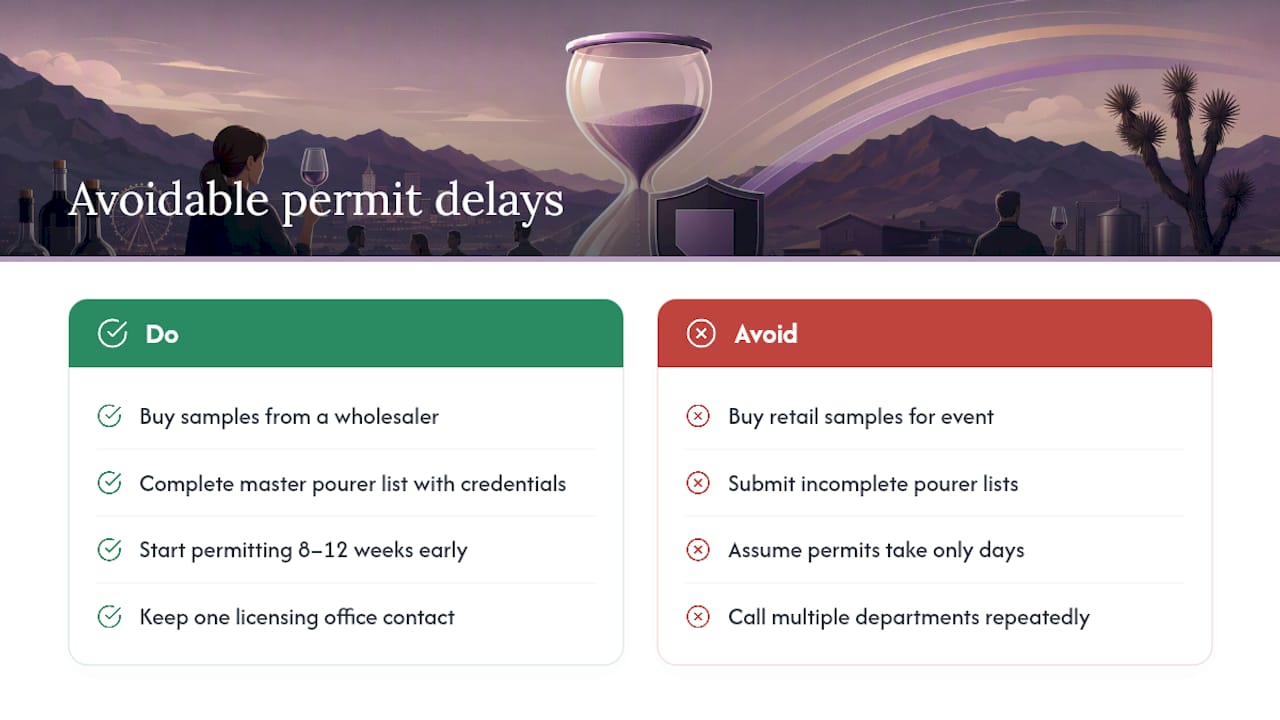
Purchasing has a hard rule most first-time organizers don’t know about. Samples must come from licensed wholesalers, not retail shelves, unless a specific exception applies. Buying a case of wine from a big-box store to pour at your tasting technically violates the sourcing requirement under NRS 597.225, even if every other part of your permit is in order. This trips up more small retailers than any other single rule.
Statistic Callout: The tasting permit itself costs nothing in Clark County, per the PL108 application, but suppliers bringing product in from out of state face a $50 initial certificate of compliance fee plus a $50 annual renewal, according to the Nevada Department of Taxation. The permit is free. The supply chain behind it usually isn’t.
Other operational rules to lock down before doors open:
- Sample sizes and serving frequency limits apply under NRS 597.225 and vary by product category, so confirm exact volumes with your local licensing office rather than assuming a standard pour size.
- Age verification is mandatory for every pour, no exceptions for “regulars” or repeat customers.
- Local time, place, and manner restrictions can limit sampling hours or require samples to stay within a defined booth or station area.
- Noncompliance risks range from permit suspension to fines, and repeat violations can jeopardize the underlying retail liquor license itself, not just the sampling privilege.
Fees, Renewals, and Realistic Timelines
Budgeting for permits gets confusing fast because fee structures differ by permit type, not by a flat statewide rate. Here’s what actually shows up on the invoice.
The Alcoholic Beverage Tasting Permit in Clark County has no fee attached, a detail confirmed directly on the PL108 application. Liquor caterer permits and off-premise station permits, by contrast, typically run on a per-day rate structure, and the Clark County Temporary Events FAQ notes that application fees for temporary events are often nonrefundable even if the event doesn’t happen as planned.
At the state level, the fee picture is narrower but firm. Out-of-state suppliers seeking a certificate of compliance pay a $50 initial fee, with a $50 annual renewal, per Department of Taxation guidance. These aren’t fees most event organizers will personally pay, since they apply to the supplier side of the chain, but they factor into pricing if you’re working with a smaller or newer distributor.
Renewal timing follows an annual cycle for the tasting permit specifically, meaning a retail store running ongoing sample stations needs to reapply yearly rather than treating the permit as a one-time approval. A few things push costs and complexity higher than organizers expect:
- Late filing near your event date often forces expedited review, which some jurisdictions handle by simply declining the application outright rather than rushing it.
- Large events requiring multiple permit types (tasting plus off-premise plus a separate vendor permit) multiply your fee total even when each individual permit looks cheap.
- Adding late-stage vendors or expanding your footprint after initial submission can trigger a fresh review cycle, not just an amendment.
If you’re weighing whether a professional caterer’s markup is worth it against handling licensing yourself, it helps to look at how alcohol catering tax obligations factor into that math before you decide.
Where Nevada Event Organizers Actually Lose Time on Permits
The failures that delay events aren’t usually dramatic. They’re small, avoidable gaps that snowball because nobody caught them early enough.
Sourcing is the number one issue. Organizers buy samples from a retail store because it’s convenient, not realizing that violates the wholesaler-purchase requirement under NRS 597.225. By the time an inspector flags it, the event is already underway and the damage is done, not prevented. The second most common failure is an incomplete master pourer list. Clark County requires every person distributing samples to appear on that list with valid credentials attached, and a single missing name can hold up final approval even when everything else checks out.
The third failure is simpler and more human: underestimating lead time. Organizers treat permit applications like a formality that takes a few days, when multi-permit events routinely need 8 to 12 weeks to clear review, insurance verification, and possible site inspection.
This is exactly why hiring a licensed liquor caterer changes the equation. When a caterer already holds a liquor caterer permit, the purchasing, staffing certification, and much of the compliance burden shifts to them instead of sitting entirely on the event host, a dynamic confirmed by Clark County’s own liquor and gaming guidance. You’re still responsible for venue authorization and confirming the caterer’s license is current, but you’re no longer building a master pourer list from scratch or tracking down wholesaler invoices.
A practical document checklist before you contact any licensing office: business registration, venue lease authorization, proof of liability insurance, and (if you’re not hiring a caterer) your finalized pourer list with health cards attached. Keep a single point of contact at the licensing office rather than calling different departments each time. It cuts down on conflicting answers and creates a paper trail if a question comes up later.
Pro Tip: One recurring pattern worth watching for: an event that started as a simple retail tasting but grew to include music, additional vendors, or extended hours almost always needs a permit upgrade partway through planning. Catch that shift early, because reclassifying a permit application after submission takes longer than starting with the right one.
Official Forms and Who to Contact
Three sources cover almost everything you’ll need to file correctly.
For Clark County tasting permits, use the Alcoholic-Beverage-Tasting-Permit-PL108.pdf form directly. It covers the application itself, staffing requirements, and the master pourer list format.
For statutory questions about grocery store sampling rights, cite NRS 597.225 directly. Statute mirrors on sites like Justia can help cross-check language, but the primary statute is the authoritative version.
For state-level licensing, importer or wholesaler questions, and certificate of compliance filings, the Nevada Department of Taxation’s liquor page is the correct starting point.
Quick guidance on which to use:
- Retail store wanting an in-house tasting station: PL108 through Clark County.
- Event organizer hosting a one-time public gathering: contact your county’s temporary events division directly.
- Out-of-state supplier or wholesaler: start with the Department of Taxation.
Why Hiring a Licensed Provider Changes the Permit Math
Nevada’s permit system rewards preparation and punishes assumption. The organizers who struggle most aren’t dealing with unusually strict rules, they’re dealing with the gap between how simple sampling sounds and how many moving pieces actually sit underneath it: sourcing rules, staffing certification, jurisdiction overlap between city and county.
What surprises most first-time applicants is that the free permit, the tasting permit itself, is rarely the expensive part. The cost shows up in insurance, staffing certification, and the time lost when a single missing detail sends an application back for revision. A licensed provider who already carries the right permit and certified staff removes most of that risk from the organizer’s plate, which is exactly why more corporate planners and wedding coordinators default to hiring one rather than building compliance from scratch.
If you’re planning an event that involves alcohol samples anywhere in Nevada, start the permit conversation the same week you book your venue, not the week before your event.
— Brennon
Skip the Permit Headache With Liquid Courage LV
If everything above made you consider handing the permit process to someone who already deals with it daily, that’s the point. Liquid Courage LV runs licensed Mobile Bartending and Liquor Catering in Las Vegas and Henderson, which means the staffing certifications, wholesaler purchasing, and pourer documentation this article just walked through are already handled before you ever sign a contract.
Instead of building a master pourer list and chasing health card records yourself, you get insured staff who already meet Nevada’s pouring requirements, along with Bar Rental Packages built for weddings, corporate events, and private parties. Whether you need private bartender services for an intimate gathering or dry hire staffing for a larger production, the compliance groundwork is already built into the service.
To get a quote, reach out through the site and include your event date, location, estimated guest count, and the type of permit situation you’re dealing with (retail tasting, private event, or corporate function). That’s enough for the team to tell you exactly what’s covered and what, if anything, still needs your attention.
Sources
FAQ
How much does an alcohol sampling permit cost in Nevada?
The Alcoholic Beverage Tasting Permit in Clark County carries no fee, according to the PL108 application. Other permit types, like liquor caterer or off-premise station permits, typically have per-day fees and sometimes include nonrefundable application fees, per the Clark County Temporary Events FAQ.
Which states require alcohol sampling permits?
Requirements vary widely by state, but Nevada specifically requires a permit for grocery store sampling under NRS 597.225, plus separate temporary permits for off-premise events. Check your local licensing authority since rules and fee structures differ even between neighboring states.
How much does it cost to get a liquor license in Nevada?
Liquor license costs depend heavily on the license type and jurisdiction, with state-level certificate of compliance fees starting at $50 initially and $50 annually for renewal, per the Nevada Department of Taxation. Local retail or event permit fees are set separately by each city or county.
Can you drink alcohol publicly in Nevada?
Public drinking rules depend on the specific jurisdiction and location, since some areas like parts of the Las Vegas Strip allow open containers under specific conditions while others restrict it entirely. For events involving sampling in public spaces like parks, check local park alcohol permit rules before assuming any location allows it.
Do I need a separate permit if I hire a caterer for alcohol service?
If your caterer already holds a liquor caterer permit, much of the compliance burden shifts to them, but you’re still responsible for confirming venue authorization and that their license is current and active. Always ask to see the caterer’s permit before the event date, not on the day of service.